

Global campaigns need more than just word-for-word accuracy to evoke the right emotions in international markets. When brands expand across borders, they quickly discover that converting text from one language to another rarely captures the emotional resonance that drives purchasing decisions. This is where the term transcreation enters the conversation – a creative process that blends translation and creative adaptation to ensure brand messages land with the same implications across different cultures.
This guide covers the fundamental differences between standard translation and full transcreation, focusing on global marketing communications, brand messaging, and the cultural adaptation required for successful international expansion. Marketing managers, brand strategists, and localization professionals expanding into various markets will find practical frameworks for deciding when each approach serves their campaigns best.
Direct answer: Transcreation prioritizes emotional impact and cultural relevance over literal translation, making it essential when global audiences need to feel – not just understand – your message. While standard translation preserves original meaning with linguistic precision, transcreation adapts the intended message to resonate authentically within each target market’s cultural context.
By the end of this article, you will understand:
- When to choose transcreation vs. translation for different content types
- How cultural nuances shape marketing effectiveness across different regions
- The strategic transcreation process for implementing global campaigns
- Methods for measuring whether a successfully transcreated message evokes the intended response
- Budget and timeline considerations for both approaches
Understanding Standard Translation
Standard translation focuses on accurately rendering text from a source language into a target language while preserving meaning, style, and grammatical structure. This approach serves critical functions across industries where precision matters more than creative expression – think legal documents, technical manuals, medical information, and regulatory compliance materials.
For brands, straightforward translation works exceptionally well for content where the primary goal is to convey information without ambiguity. Professional translators working on these projects prioritize faithfulness to the source text, ensuring nothing gets lost or inadvertently added during the conversion process.
Word-for-Word Accuracy Focus
Literal translation operates on the principle that the source text’s structure and vocabulary should be mirrored as closely as possible in the target language. This method maintains original message integrity and ensures legal compliance – essential when translating contracts, safety warnings, or documentation that may face regulatory scrutiny.
Translation memory tools and translation technology support this accuracy-focused approach by storing previously translated segments for consistency across large volumes of content. When a legal document requires translation into multiple languages, these systems ensure identical phrasing throughout, reducing both error rates and costs.
Linguistic Precision Applications
Technical documentation demands this precision-first methodology. Engineering specifications, pharmaceutical dosage instructions, software user guides, and scientific research papers cannot afford creative interpretation. A good translation in these contexts means the reader in their own language receives exactly the same instructions as someone reading the original.
Language professionals working in technical fields develop deep specialization in terminology and regulatory requirements. Their expertise lies not in creative adaptation but in meticulous accuracy – ensuring that translated content functions identically to the source material.
Cost-Effectiveness for Volume Content
Standard translation rates typically range from $0.08 to $0.25 per word, making it cost-effective for high-volume informational content like product descriptions, help documentation, and internal communications. When emotional resonance isn’t the objective, translation services deliver reliable results at predictable costs.
However, this cost efficiency comes with limitations. Marketing translations handled through direct translation often produce technically correct but emotionally flat results – setting up the need for a different approach when brands aim to create content that moves target audiences to action.
The Art of Transcreation in Marketing
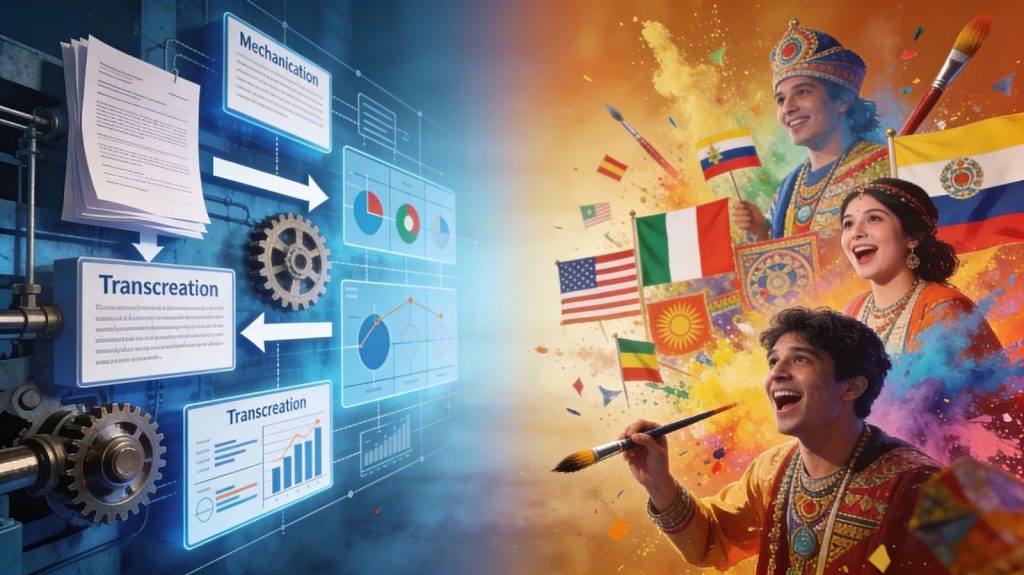
Where standard translation ends, transcreation begins. This art form goes beyond converting text between languages – transcreation involves reimagining content so that a successfully transcreated message evokes the same emotional response in the target audience as the original did in its home market.
Creative Adaptation Principles
Transcreation differs from translation in its fundamental objective. While translation asks “How do I say this in another language?”, transcreation asks “How do I make the local audience feel what the original audience felt?” This creative translation approach may result in completely different words, metaphors, or concepts – but the emotional impact remains aligned with brand intent.
Consider how transcreation adapts advertising slogans. Intel’s “Sponsors of Tomorrow” worked beautifully in English but created problems in the Chinese market and Brazilian Portuguese, where literal translation implied promises that might not be kept immediately. The transcreation process required rethinking the message entirely to preserve the forward-looking optimism without the problematic implications.
Creative briefs for transcreation projects specify the desired emotional response, brand personality attributes, and campaign objectives rather than simply providing text for conversion. This deep understanding of intent enables transcreators to make bold creative choices that serve the brand’s goals.
Cultural Context Integration
Effective transcreation requires immersion in local market preferences, cultural values, and communication styles unique to each target market. Cultural references that resonate in one region may fall flat or cause offense in another. The shift from “Black Friday” to “White Friday” in Arabic-speaking markets illustrates this principle – the color black carries mourning associations that would undermine a celebration-focused shopping event.
Japanese culture, for example, values indirect communication and group harmony differently than Western markets emphasizing individual achievement. Marketing messages that work through bold, direct claims in English-speaking markets may require softer, more community-oriented framing to achieve cultural relevance in Japan.
This cultural adaptation extends beyond words to visual elements, color choices, and even the fundamental value propositions emphasized. Market research into cultural preferences shapes every aspect of how transcreation works in practice.
Brand Voice Preservation Through Adaptation
Maintaining consistent brand voice across different languages presents a paradox: being recognizably the same brand while speaking authentically in each local audience’s cultural context. A brand known for playful irreverence in English needs equally playful irreverence in Portuguese or Mandarin – not translated jokes that land awkwardly, but culturally native humor that creates the same brand experience.
Transcreation professionals function as creative partners rather than linguistic converters. They understand that localized content must feel original to local readers while remaining unmistakably on-brand. This dual requirement – authenticity plus consistency – makes transcreation both more challenging and more valuable than standard translation for marketing content.
Implementing Transcreation for Global Marketing Campaigns
Building on these creative adaptation principles, implementing transcreation successfully requires structured processes that balance creative freedom with brand governance. Organizations expanding into international markets need clear frameworks for deciding which content requires transcreation and how to execute it effectively.
Strategic Campaign Adaptation Process
When global campaigns require transcreation, the following process ensures consistent quality across markets:
- Market research and cultural analysis – Investigate local values, communication norms, competitor positioning, and cultural sensitivities before any creative work begins. This foundation prevents costly missteps and informs the creative brief.
- Creative brief development with local insights – Document campaign objectives, emotional targets, brand voice requirements, and specific cultural considerations for each market. The brief guides transcreators while preserving creative space.
- Collaborative adaptation with native copywriters – Engage language professionals who combine native-level cultural intuition with marketing copywriting skills. These transcreation services differ from translation services in requiring creative capability alongside linguistic expertise.
- Cultural testing and feedback integration – Pre-test transcreated messages with representative local audiences. Gather qualitative feedback on emotional response, brand perception, and cultural appropriateness before final approval.
- Final approval and deployment across markets – Ensure global brand governance reviews all transcreated content while respecting local expertise. Coordinate timing for simultaneous or phased market launches.
For a deeper understanding of the core principles behind adapting different types of content, our business translation guide covers everything from technical manuals to marketing transcreation.
Transcreation vs. Translation Comparison
Understanding which approach fits your content requires evaluating multiple factors:
| Criterion | Standard Translation | Transcreation |
| Primary Goal | Linguistic accuracy and meaning preservation | Emotional impact and cultural resonance |
| Creative Freedom | Constrained by source text structure | Significant latitude to reimagine concepts |
| Cultural Adaptation | Language-level adjustments only | Deep cultural context integration |
| Cost Investment | $0.08–$0.25 per word | $0.25–$1.00+ per word (3-4× higher) |
| Timeline Requirements | Faster turnaround, fewer iterations | Extended for creative development and testing |
| Suitable Content Types | Technical docs, legal texts, specifications | Slogans, advertising, website content, campaigns |
Choose transcreation when your content must create an emotional connection – when you need global audiences to feel something specific. Choose translation when accuracy matters more than feeling – when conveying information correctly is the primary goal.
Data supports this distinction: brands using transcreation for marketing content report 73% better conversion rates and 156% higher engagement compared to direct translation approaches. One luxury watch brand documented a 2,600% ROI on transcreation investment after comparing market performance between literally translated and transcreated campaign versions.
Common Challenges and Solutions
Implementing transcreation across different markets introduces predictable obstacles. Understanding these challenges in advance allows for proactive solutions.
Budget Constraints and ROI Concerns
Transcreation costs significantly more than standard translation – a reality that requires strategic market prioritization. Not every market needs full transcreation for every piece of content. Prioritize transcreation investment for tier-one markets with highest revenue potential, highest cultural distance from source content, or highest brand-building importance.
Phased rollout approaches allow learning from early markets before expanding investment. Track engagement and conversion metrics rigorously to build internal ROI data that justifies continued transcreation investment.
Maintaining Brand Consistency Across Markets
With creative teams in various markets adapting content, brand voice can drift without strong governance. Develop comprehensive brand guidelines that specify non-negotiable elements (visual identity, core values, positioning) while explicitly allowing cultural adaptation of expression.
Establish collaborative review processes where global brand teams and local transcreation partners align before final deployment. Regular cross-market sharing sessions help teams learn from each other’s cultural adaptations while maintaining coherent brand identity.
Cultural Sensitivity and Local Relevance
Even with transcreation, cultural missteps remain possible when cultural consultation lacks depth. Require native market expertise on every transcreation project – not just language fluency but genuine cultural embeddedness. Pepsi’s infamous “brings your ancestors back from the dead” translation failure in China, or HSBC’s $10 million global rebranding after “Assume Nothing” became “Do Nothing,” demonstrate the cost of insufficient cultural insight.
Build feedback loops that capture local audience response after launch, enabling continuous refinement of transcreation approaches across markets.
Conclusion and Next Steps
Translation and transcreation serve fundamentally different purposes in global communication. Standard translation delivers accuracy and efficiency for informational content where meaning preservation matters most. Transcreation ensures that the same message creates the same emotional impact across different languages and cultural contexts – making it essential for marketing content where feeling drives action.
Organizations expanding internationally should take these immediate steps:
- Audit current global content – Categorize existing translated materials by content type and assess whether transcreation would improve marketing effectiveness
- Identify priority markets – Determine which markets warrant transcreation investment based on revenue potential and cultural distance from source content
- Develop cultural brief templates – Create standardized frameworks capturing emotional objectives, brand voice requirements, and cultural considerations for transcreation projects
- Establish budget and timeline planning – Build transcreation costs and extended timelines into campaign planning from the start rather than treating them as translation add-ons
As machine translation technology advances, the gap between automated translation and human transcreation will likely widen rather than narrow. AI handles linguistic conversion increasingly well but struggles with cultural nuances and emotional resonance that require human creative judgment. Brands investing in transcreation capabilities today build competitive advantages that become harder for technology-only approaches to replicate.
Frequently Asked Questions
When should I choose transcreation over standard translation?
Choose transcreation when content must evoke emotional responses – advertising campaigns, taglines, brand storytelling, website content, and social media that requires local audience connection. Use standard translation for technical documentation, legal texts, specifications, and informational content where accuracy outweighs creative impact.
How much more does transcreation cost compared to regular translation?
Transcreation typically costs 3-4 times more than standard translation, ranging from $0.25 to $1.00+ per source word or $75-$250+ per hour, compared to $0.08-$0.25 per word for translation. The higher investment reflects the creative expertise, cultural consultation, and iterative process required.
Can transcreation work for all types of marketing content?
Transcreation delivers highest ROI for high-impact, emotionally-driven content like campaign headlines, slogans, and brand messaging. Lower-funnel content like product descriptions or transactional emails may warrant a hybrid approach – translation plus localization – rather than full transcreation.
How do I measure the success of transcreated campaigns?
Track engagement metrics (click-through rates, time on page, social shares), conversion rates, brand recall studies, and sentiment analysis. Compare performance between markets using transcreation versus direct translation to quantify impact. A/B testing transcreated versus translated versions provides direct attribution data.
What qualifications should I look for in a transcreation professional?
Seek native-level fluency in the target language combined with proven marketing copywriting experience, demonstrated cultural knowledge, portfolio examples of creative adaptation work, and comfort with collaborative feedback processes. Transcreators should understand brand strategy and persuasion principles, not just language conversion.
How long does the transcreation process typically take?
Timelines vary by scope. A single tagline for one market may take one week including cultural testing. Full campaigns across multiple languages require several weeks to accommodate market research, creative development, iteration cycles, and approval processes – significantly longer than standard translation timelines.