
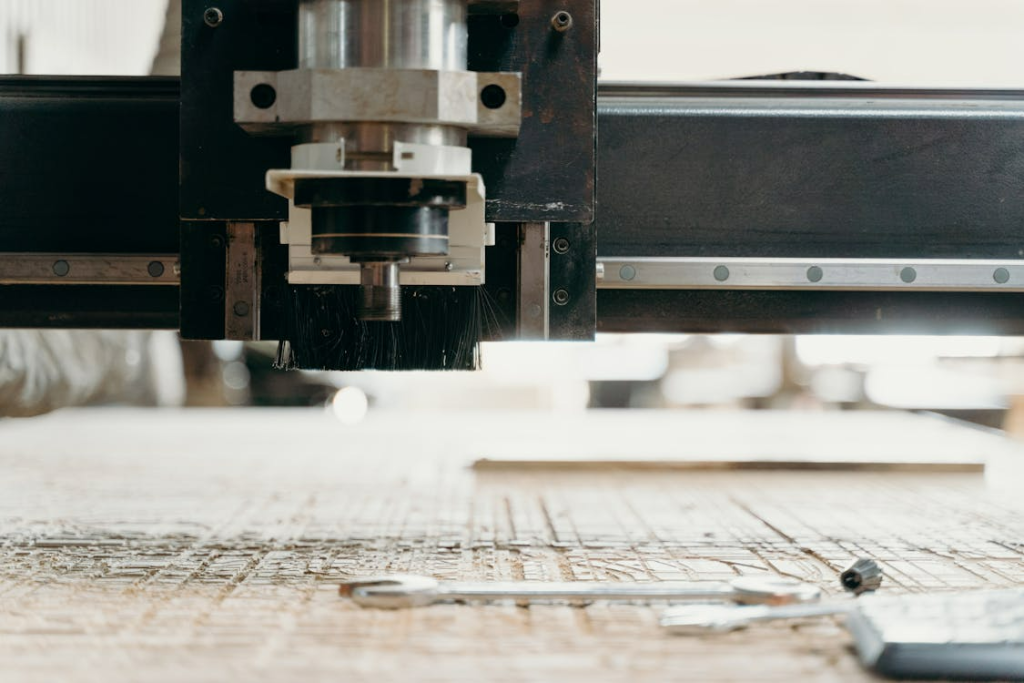
The face of the manufacturing sector has witnessed a radical transformation over the past years. We have progressed from a time when the workforce was manual and the manufacturing machines to a future where automation and precision play a prominent part. Leading the revolution in the manufacturing sector is the Computer Numerical Control (CNC) machine. The CNC machine has become an integral part of the business world, ranging from giant manufacturing units to individual workshops, as it fills the gap between mass uniformity and creativity.
Understanding CNC Machining
To understand the significance of such devices, one needs to have a basic understanding of their workings. CNC machining is a form of subtractive manufacturing. The process involves the use of pre-programmed computer-based software that controls various tools within a factory. This manufacturing process is able to control various types of complicated machinery such as grinders, lathes, mills, as well as CNC routers. CNC machining allows for the cutting of three-dimensional objects in a single set of instructions.
This technology overcomes the limitations of the human-controlled system because the system requires the assistance of operators in prompting the machining tools in their operation using levers, buttons, and wheels. To one observing the system, a CNC system may seem like a conventional system of computer parts, but the software programs used in the CNC system make it unique compared to all other forms of computation because of the level of accuracy one can attain without the use of the human hand.
CNC Machines in Mass Production
In mass production, efficiency is a critical factor. CNC machines are most effective in a situation where one needs thousands of similar parts with zero tolerance. After a design is approved and the code is programmed, the machine will be able to churn out those specific parts endlessly. This would enable a company to easily increase production with minimal increase in labour costs.
Moreover, these systems can also operate on their own for an extended period of time, which is known as “lights out manufacturing.” A shop floor can work even during the nighttime with less human intervention, which can decrease lead times immensely. One of the major advantages of using the NSP technique in high-volume production is the elimination of waste. Since the machine considers the shortest path of the cutting tool to the material, the material used is minimised, thus giving an immense cost advantage to the process. So long as you keep up with specialist CNC machine repairs, it’ll keep going for you.
CNC in Custom Fabrication – Advantages
Although it is quite impressive to see such high volume rates, it is even more important to realise the flexibilities that CNC has when it comes to custom fabrication work. In fact, being able to manufacture a “batch of one” can be even more valuable for some Australian companies compared to the ability to manufacture a million.
The CNC machine enables the fabricator to easily switch between designs in a matter of seconds, provided a digital file of the design exists. The ability offered by CNC builds on the idea of prototyping and enables engineers and designers to test a physical part and then revise the digital copy in order to extract a new part in hours.
When speaking of a customised part required in old car restoration or when it comes to the mining industry’s heavy machinery, CNC offers the required customisation of these products without requiring the steep price tags traditionally associated with one-off manufacturing.
Embracing CNC for Manufacturing Excellence
The challenge posed by mass production and customisation is a thing of the past for manufacturers. This is due to the uniform solutions offered by CNC machines that meet both ends of the spectrum. Through this technology, businesses can be assured that they are equipped to handle the tough requirements of the market concerning speed and volume production, while still being adept at innovation and customisation.
As this technology becomes more mainstream, companies have no choice but to adopt CNC as a means to keep up in a tough industry.